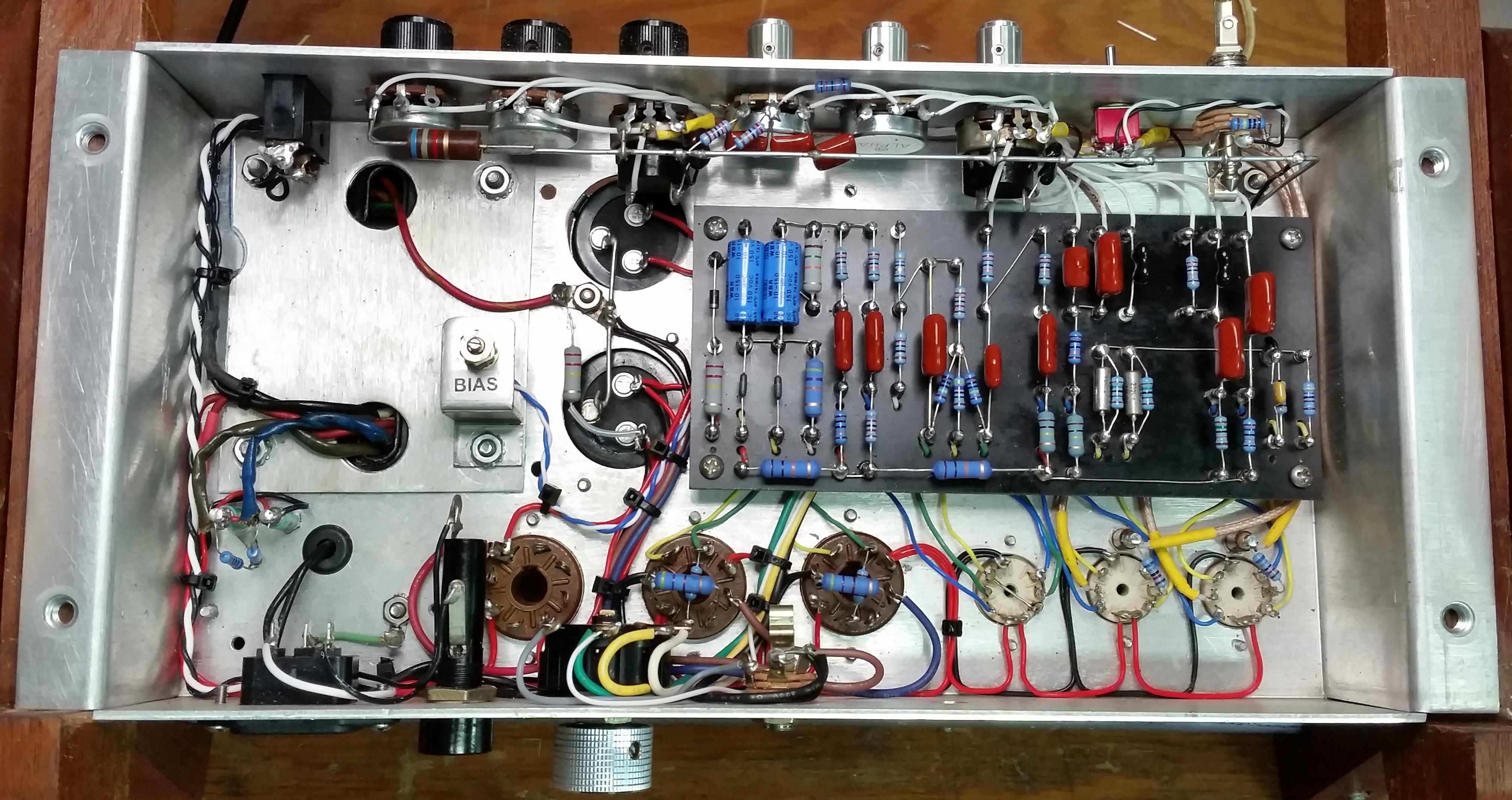
Lots of playing and tweaking in the past couple of months.
First, it's sounding good and markedly different with each of my main guitars, and it looks good... er... rather, it looks innocuous, like a proper amp. It's fairly noise-free, but not dead quiet (I will go back in at some point and re-line the chassis area of the cabinet with ground-able foil), and a little hissier than Scarlett. It provides decent clean tones and a unique overdriven lead sound, and has plenty of volume for most club venues.


PRE-AMP
Nice clean tones from the two-stage 12AY7 input channel up to nearly full pre-amp gain settings - the Telecaster has slightly "cooler" pickups so doesn't drive the first stages quite so hard and develops just a slightly hairy shimmer at full gain on the dial, whereas the MC5 gets a bit more crunchy with the input gain at 10, especially in humbucker mode. The tone from the preamp is somewhat thin at gain levels lower than 6 on the dial, for both guitars, but the audio spectrum fills out quickly from there and stays crystal clear until 8-9, when it starts to break up.
The Bass, Mid and Treble tone controls are very interactive and while I can eventually dial in a good balance of highs, mids and low end, I do wish the controls were deeper in each of their respective bands. I may try increasing the cathode bypass capacitor on the input stage to boost the bottom end, but need to be careful as this will impact the overdrive stage as well, which doesn't want to see a lot of low frequencies.
The tone controls function by dumping various frequency ranges of the signal to ground, reducing the overall strength of the signal. The pre-amp boost (PAB) switch works as planned, inhibiting the cutting of any signal. The result is a nearly full raw signal passed without any tone shaping. So far I haven't found this useful as the signal is too bright and sharp without some shaping. Again, this may be improved by upping the cathode bypass cap, but it's not a priority. In this case, the feature was not worth the effort of providing its own footswitch, LED, and relay, but it was a good experiment.
OVERDRIVE
Another pair of 12AY7 triodes, lots of local negative feedback, and another tone control shape the sound produced by this stage. Even at lower gain levels, this part of the circuit gives the signal more sustain and is moderately but not overly mid-focused. This stage is fed entirely by the pre-amp, so gain in that stage directly drives the input gain of the OD stage - when the pre-amp is dialed up to 7 or higher, the signal produced by the initial stage of the OD rounds off nicely, producing a softly distorted tone. The second stage of the OD section is then controlled through the "Drive" knob, which produces a "thickening" of the tone and then additional distortion from about 5 and higher on the dial. The tone control works well to dial down high end harshness. Not surprisingly, settings here also really depend on the guitar used, the pickups selected, and the tone control settings in the pre-amp section.
FX LOOP
This feature works amazingly well... hard to believe actually, since I don't fully understand the principles of signal to circuit impedance and there are no definitive best models of this kind of thing. I made some educated guesses about how this part of the circuit should look, and it just works. The Line6 HD500 stereo effects unit does its part well also, and presents what seems to be a suitable signal to the power section drivers. I can return a left and right stereo effects signal to the amp, or a single mono effect signal to one channel leaving the other channel totally "dry", with only the unaffected signal from the amp, in a wet/dry configuration. This wet/dry setup preserves the amp's touch-sensitive immediacy and sharpness in one channel, which is reduced when the whole signal is sent through the HD500 (it's subtle, but noticeable to the player if not the listener), while also providing effects in the other channel.
The two effects pedals I have don't work well in the FX Loop, but I haven't really tried to address that since I use the HD500 unit. This has to do with impedance matching and buffering, but as I said, I don't have a good enough theoretical grasp on it to explain.
POWER SECTION
It's a pair of separate individually operating output amps, each fed separate signals from the FX return part of the circuit.

The 5881 tubes operate at somewhat lower power than Scarlett's 6L6CG, which means they are slightly quieter, and have slightly different tonal and distortion characteristics. I tried a pair of 6L6s in this amp and they sounded anemic and empty by comparison. I think this means my choices for output transformer (Fender Princeton style, 15W) and driver configurations that were made with the 5881s in mind, turned out to be right... or right enough, since I have little experience to compare. The drivers (12AX7) put as much as 25vac (rms) of signal (1KHz test) onto the grids of the 5881s, which is plenty to drive them past their range of linear operation (up to about 18vac peak), and both clean and OD amp settings produce a gradually breaking up and progressively more compressed tone. Pretty much all that I hoped for.

Measurements (using my nifty new scope, see below) show this amp provides about 10 watts clean to each speaker and up to about 15 watts max (actual power output varies across audio frequencies).
SPEAKERS
I started with one stock Fender speaker from the donor amp, and one 10" rock-oriented (mid-focused) speaker, just to get sense of tonal range and response. This amp, as well as Scarlett, are capable of producing nice cleans as well as moderate gain tones, so I wanted to support both. Initial tests with the first set of speakers gave me enough info and confidence to select a pair of nicer speakers to support a broad range of sound, so I currently have a Jupiter 12LC and a Weber DT12, which sound great separately and blended together. I configured the combo to allow them to run separately or in series, so while they are mounted in the combo, either amp can be plugged into one or both of them.
BUGS
There's a niggling problem I haven't been able to solve. Here's an initial query I put to one of the amp forums I look at, back in mid June:
"[...] A version of the input signal from the preamp, and especially from the OD section, is appearing on one grid (Left side, V3 pin 2) of the power section driver, and is loud enough at high gain settings to make FX loop volume pedal (as well as the Fx send pot) ineffective for shutting down the sound. The other grid (V3 pin 7) is almost dead quiet and seems to work as expected. The frustrating part is I don't understand why the difference between the two identically configured channels. The offending channel is a little closer to the preamp circuitry, but moving the wires around doesn't really confirm that is an issue. There are slight differences (< 5vdc) in the two plate voltages for V3, though I'm not sure how that could be significant. All of this is compounded by my lack of real understanding of capacitive vs. inductive coupling (presumed related to the problem?), and my general inexperience with with circuit design."
And here's my final post on it a few days ago:
"This issue is beyond me. I've updated the power supply nodes, checked and re-checked lead dress, added shielding to vulnerable leads, tested additional coupling caps. Thanks to your suggestions, I do think the rogue signal is coming in through the plate of the driver (V3b), but I'm out of ideas and energy for it. The truth is, it's more of an annoyance than a practical problem: it's significant in the left channel at very high gain only, and only when I'm trying to shut down the signal using a volume pedal in the Fx loop. It's just not a problem at all in the right channel (which is exactly the same as the left! ugh!), so if I need to, I can just mic up that speaker for recording and silence the other. Thanks for all the help and suggestions! On to the next..."
To help track down the problem, and trouble shoot circuits in the future, actually got my hands on an old analog oscilloscope, which has been fun to learn and play with... it did provide some useful data for ruling out possible causes, but (this one) can't be used to look at audio (AC) signals mixed with high voltage DC, which is what's going on.

So, overall, the amp's not perfect, but it's pretty darn good, and covers different sonic territory than Scarlett. I'll work on getting some decent audio clips together to update this post.
I've discovered that FedEx/Kinko's will custom print fairly cheaply on adhesive weatherproof vinyl, so I'll likely give that a try for making a new set of labels for the front panel, that actually match the knob functions.
THE THING IS
The thing is, I still have a very nice Classic Tone output transformer, a salvaged 8"x16" chassis, lots of pots, resistors, caps, and other bits and bobs laying around that are just going to waste sitting there... I have always loved the HiWatt sound (David Gilmour, Pete Townsend, Joe Walsh, etc.), so...